For years, the Tempo electricity tariff has been hailed as a innovative way for French households to take control of their energy use and save money. But as the country grapples with rising prices, a growing number of consumers are abandoning Tempo in favor of EDF’s regulated tariff, signaling a shift in the energy landscape.
The move away from Tempo reflects a growing desire for stability and predictability in uncertain times, as French families seek a respite from the daily juggling act of optimizing their electricity use. What was once seen as a smart savings tool has increasingly become a daily headache, leading many to yearn for a simpler, more straightforward approach to powering their homes.
This trend offers a glimpse into the future of Europe’s energy habits, as households across the continent navigate the complex and ever-evolving landscape of electricity tariffs and smart-home technologies.

From Smart Savings Tool to Daily Headache
Tempo, introduced by EDF in 1996, was designed to incentivize energy-efficient behavior by offering variable pricing based on the time of day and season. Households could save money by shifting their electricity usage to off-peak hours, effectively becoming active participants in the grid’s optimization.
For many French families, Tempo represented a novel way to take control of their energy consumption and reduce their bills. But as the years have passed, the complexity of the system has become a source of frustration, with the daily need to adjust routines and monitor prices adding stress to already busy lives.
As Camille, a Parisian resident, explains, “It just became too much of a hassle. I was constantly checking the app, trying to figure out the best times to run the washing machine or the dishwasher. It felt like a part-time job, and I just wanted to go back to a simpler, more predictable system.”

When Tempo Stops Beating the Regulated Tariff
The shift away from Tempo has been further exacerbated by the fact that the regulated tariff, known as the “tarif bleu,” has in many cases become more economical than the Tempo system. As energy prices have soared, the variable pricing of Tempo has not always kept pace, leading to situations where the regulated tariff offers a more cost-effective option.
This reversal has caught many Tempo users off guard, as the promise of savings has been undercut by the realities of the current energy market. For some households, the administrative burden of managing Tempo has simply become too much to justify the potential savings.
“I used to be a huge advocate for Tempo, but now it just doesn’t make sense anymore,” says Sophie, a Tempo user in Lyon. “The regulated tariff is often cheaper, and I don’t have to worry about constantly adjusting my habits. It’s a relief to have that stability back.”

Stability Beats Perfect Optimization
The shift away from Tempo highlights a broader trend in French households’ energy preferences. As the country grapples with the fallout from the energy crisis, many consumers are prioritizing stability and predictability over the pursuit of perfect optimization.
This shift reflects a growing desire for simplicity and control in a world that can feel increasingly complex and uncertain. Instead of constantly juggling the demands of the Tempo system, French families are opting for the regulated tariff, which offers a clear and straightforward pricing structure.
“At the end of the day, what people want is the ability to budget and plan their energy use without the constant stress of trying to game the system,” says Jean-François Carenco, the president of the French Energy Regulatory Commission (CRE). “The regulated tariff provides that stability, and that’s become increasingly important for many households.”
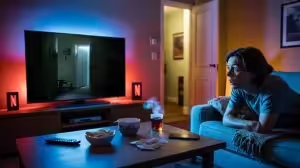
A Window into Europe’s Future Energy Habits
The exodus from Tempo in France offers a glimpse into the broader energy landscape in Europe, where consumers are grappling with the complexities of smart-home technologies and variable pricing structures.
As countries across the continent work to decarbonize their energy systems and integrate more renewable sources, the need for active consumer participation in the grid has become increasingly important. But the challenges of managing these systems can be daunting, leading some households to seek the comfort of more traditional, regulated approaches.
“What we’re seeing in France is likely a harbinger of things to come in other European countries,” says Dr. Sylvia Medina, an energy policy expert at the University of Groningen. “As the energy transition accelerates, consumers will be looking for solutions that balance innovation with simplicity and stability. The regulated tariff may emerge as a surprisingly popular option.”

What “Regulated Tariff” and “Tempo” Really Mean in Practice
The regulated tariff, or “tarif bleu,” is EDF’s default electricity offering in France. It features a fixed price per kilowatt-hour, with adjustments made periodically by the government to reflect changes in wholesale energy costs.
In contrast, the Tempo tariff is a dynamic pricing system that offers three different rates depending on the time of day and season. Customers are charged higher prices during “peak” hours and lower prices during “off-peak” hours, with the goal of incentivizing energy-efficient behavior.
While Tempo was designed to help households save money, the complexities of the system have proven to be a barrier for many consumers. The need to constantly monitor and adjust their electricity usage has become a source of stress, leading some to seek the simplicity of the regulated tariff.
| Regulated Tariff (“Tarif Bleu”) | Tempo Tariff |
|---|---|
|
– Fixed price per kilowatt-hour
– Periodic adjustments by the government – Predictable and stable pricing |
– Three different rates based on time of day and season
– Higher prices during “peak” hours, lower prices during “off-peak” – Designed to incentivize energy-efficient behavior |
Practical Scenarios French Households Weigh Up
As French households evaluate the pros and cons of the Tempo and regulated tariffs, they must consider a range of practical factors that impact their daily lives and energy use.

For families with young children or irregular schedules, the administrative burden of managing the Tempo system may outweigh the potential savings. The need to constantly monitor energy prices and adjust routines can be overwhelming, leading many to prioritize stability over optimization.
On the other hand, households with more flexible schedules or a strong interest in energy efficiency may still find value in the Tempo tariff, as the ability to shift usage to off-peak hours can result in significant savings. However, as the regulated tariff becomes more competitive, the calculus for these households is also shifting.
“The Tempo tariff used to be a no-brainer for us, but now the numbers just don’t add up the way they used to. We’re seriously considering switching back to the regulated tariff for the sake of simplicity and peace of mind.”
– Marie, a Tempo user in Bordeaux

Ultimately, the decision to stick with Tempo or switch to the regulated tariff is a highly personal one, dependent on a household’s specific energy needs, financial situation, and tolerance for complexity.
The Evolving Landscape of Energy Tariffs
The shift away from Tempo in France is part of a broader trend in the energy sector, as households and policymakers grapple with the challenges of the energy transition and the need to balance innovation with stability.

“As we move towards a more decentralized, renewable-powered grid, the role of the consumer will become increasingly important. But we have to find ways to make that participation accessible and empowering, not burdensome.”
– Dr. Sylvia Medina, energy policy expert at the University of Groningen
In the years ahead, we may see a continued evolution of energy tariffs and smart-home technologies, with a greater emphasis on simplicity, transparency, and user-friendliness. The regulated tariff, once seen as a relic of the past, may emerge as a surprisingly popular option in a world where consumers crave stability and control.
As the energy landscape continues to shift, the choices made by French households will offer valuable insights into the preferences and priorities of consumers across Europe. The story of Tempo and the regulated tariff is more than just a local phenomenon – it’s a window into the future of energy use and the challenges that lie ahead.
FAQ
What is the “tarif bleu” in France?
The “tarif bleu” is the regulated electricity tariff offered by EDF in France. It features a fixed price per kilowatt-hour, with periodic adjustments made by the government to reflect changes in wholesale energy costs.
How does the Tempo tariff work?
The Tempo tariff is a dynamic pricing system that offers three different rates depending on the time of day and season. Customers are charged higher prices during “peak” hours and lower prices during “off-peak” hours, with the goal of incentivizing energy-efficient behavior.
Why are some French households abandoning Tempo for the regulated tariff?
Many French households are finding the Tempo tariff too complex and burdensome to manage, with the constant need to monitor energy prices and adjust their routines becoming a source of stress. Additionally, in some cases, the regulated tariff has become more economical than Tempo, leading households to opt for the simpler and more predictable option.
What are the key differences between the Tempo and regulated tariffs?
The main differences are:
– Tempo has variable pricing based on time of day and season, while the regulated tariff has a fixed price per kilowatt-hour.
– Tempo is designed to incentivize energy-efficient behavior, while the regulated tariff offers a more straightforward and stable pricing structure.
– Tempo requires more active management and monitoring by the customer, while the regulated tariff is more hands-off.
How does the shift away from Tempo in France reflect broader trends in Europe’s energy landscape?
The move away from Tempo in France offers a glimpse into the evolving preferences of European consumers as the energy transition accelerates. As households grapple with the complexities of smart-home technologies and variable pricing structures, many are seeking the stability and simplicity of more traditional tariff options, like the regulated tariff.
What factors do French households consider when choosing between Tempo and the regulated tariff?
Key factors include the household’s energy needs, financial situation, and tolerance for complexity. Families with irregular schedules or young children may prioritize the stability of the regulated tariff, while households with more flexible routines may still find value in the potential savings of Tempo.
How might the energy tariff landscape evolve in the coming years?
Experts predict that as the energy transition accelerates, there will be a greater emphasis on simplicity, transparency, and user-friendliness in energy tariffs and smart-home technologies. The regulated tariff, once seen as outdated, may emerge as a surprisingly popular option as consumers seek stability and control in a rapidly changing energy landscape.
What is the role of the consumer in the energy transition?
The energy transition will require active participation and engagement from consumers, as households become increasingly integrated into the smart grid. However, as the French example of Tempo shows, this participation needs to be accessible and empowering, not overly burdensome. Finding the right balance between innovation and simplicity will be a key challenge for policymakers and energy providers in the years ahead.
Originally posted 2026-02-28 00:00:00.