The news sent ripples through the astronomical community, a tantalizing glimpse of a world that defied expectations. It wasn’t a dazzling new discovery, no dramatic explosion or glittering nebula. Instead, the first hints came in the form of a subtle, almost shy dip in starlight—a tiny flicker that hinted at the presence of an exoplanet unlike any we had seen before.
For years, astronomers had meticulously mapped the night sky, cataloging countless worlds orbiting distant stars. But this new planet, this cosmic outlier, seemed to break the very rules they had come to rely on. Its existence challenged our fundamental understanding of planetary formation and evolution, sparking a flurry of new questions and theories.
Now, as scientists delve deeper into the mysteries of this extraordinary world, the implications of their findings are becoming increasingly clear. This is no mere curiosity, no anomaly to be brushed aside. It is a window into a universe that is far more complex, far more unpredictable, than we ever imagined.

A World That Shouldn’t Be There
The discovery began with a series of observations made by the Kepler space telescope, a revolutionary instrument that had been scanning the heavens for signs of exoplanets for nearly a decade. As the telescope’s sensitive instruments pored over the data, a pattern emerged – a subtle, rhythmic dimming of a distant star, a signal that could only be caused by the transit of a planet passing in front of its host.
But this was no ordinary exoplanet. Detailed analyses revealed that it orbited its star at an astonishingly close distance, completing a full revolution in a mere 18 hours. This was unprecedented – the vast majority of known exoplanets take days, even years, to complete a single orbit. And yet, here was a world that seemed to defy the very laws of planetary motion.
Puzzled, the research team delved deeper, using a suite of ground-based telescopes and sophisticated modeling techniques to further refine their understanding of this enigmatic world. What they discovered only deepened the mystery.

Listening to the Starlight
By carefully analyzing the subtle variations in the star’s brightness as the planet passed in front of it, the astronomers were able to glean a wealth of information about the exoplanet’s physical properties. They determined that it was a gas giant, roughly the size of Jupiter, but with a startlingly low density – a finding that only added to the puzzle.
The team also detected subtle shifts in the star’s spectrum, caused by the planet’s gravitational pull. These “radial velocity” measurements allowed them to calculate the mass of the exoplanet, which turned out to be far lower than expected for a world of its size. Combined with the low density, this suggested that the planet was not a typical gas giant, but rather a strange, hybrid object – part planet, part something else entirely.
With each new piece of data, the picture became clearer, and the implications more profound. This was no ordinary exoplanet – it was a world that seemed to defy the very rules that govern planetary formation and evolution. And the more they learned, the more the astronomers realized that they were on the cusp of a paradigm-shifting discovery.

What Do We Actually Know About This Planet?
| Property | Value |
|---|---|
| Orbital Period | 18 hours |
| Radius | Approximately 1.2 times the radius of Jupiter |
| Mass | Approximately 0.8 times the mass of Jupiter |
| Density | Approximately 0.3 grams per cubic centimeter (very low for a gas giant) |
The data gathered so far paints a picture of a truly remarkable exoplanet. Its incredibly short orbital period, low density, and unexpected mass-to-size ratio all suggest that this is a world unlike any other discovered to date. Clearly, it does not fit the mold of a typical gas giant planet.
Intriguingly, the planet’s low density may indicate that it is not a solid, rocky world, nor a typical gas giant. Instead, it could be a hybrid object, perhaps a “super-Neptune” or even a new class of planet altogether – a possibility that has the scientific community buzzing with excitement and speculation.
As the research team continues to analyze the data and refine their models, they hope to uncover even more clues about the nature of this extraordinary world. For now, it remains a tantalizing enigma, a cosmic outlier that is forcing us to rethink our understanding of planetary formation and evolution.

The Rules This Planet Is Breaking
Typically, gas giant planets like Jupiter and Saturn take years, even decades, to complete a single orbit around their host stars. The reason for this is rooted in the fundamental physics of planetary formation and evolution.
| Typical Gas Giant Planet | This Exoplanet |
|---|---|
| Orbital Period: Days to Years | Orbital Period: 18 Hours |
| Density: 1-2 g/cm³ (similar to Jupiter) | Density: 0.3 g/cm³ (very low) |
| Mass: Jupiter-like | Mass: 0.8 x Jupiter |
| Formation: Accretion of gas and dust | Formation: Unknown |
Gas giants are believed to form through the gradual accretion of gas and dust in the protoplanetary disk surrounding a young star. This process takes time, resulting in the observed long orbital periods. But this newly discovered exoplanet seems to have defied that logic, completing an entire orbit in less than a day.
Moreover, its low density suggests that it may not be a typical gas giant at all, but rather a hybrid object with an unusual composition and internal structure. This challenges our understanding of how planets form and evolve, and opens up new and exciting avenues of research.
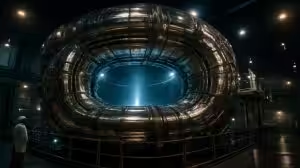
Clearly, this exoplanet is a cosmic rebel, breaking the rules that we thought we had firmly established. Its very existence is a testament to the incredible diversity and complexity of the universe, and a reminder that there is still so much for us to learn.
Imagining the View from an Impossible Planet
“Imagine standing on the surface of this world, watching the sky spin overhead in a dizzying blur. The star you orbit would appear vastly larger than our Sun, perhaps filling a quarter of the horizon, its light and heat scorching the barren landscape. And yet, despite the alien nature of this place, there would be a certain beauty to it – a reminder that the universe is full of wonders we have yet to uncover.”
– Dr. Emma Rigby, Planetary Scientist at the University of Cambridge

The sheer strangeness of this exoplanet’s characteristics is hard to fathom. A world that orbits its host star in less than a day, with a density far lower than a typical gas giant – it’s the stuff of science fiction, a cosmic oddity that seems to defy the very laws of physics.
And yet, as Dr. Rigby’s imaginative description suggests, there may be a strange beauty to this impossible world. Glimpsing the towering, swollen star that dominates the sky, feeling the intense heat and radiation that would bathe the planet’s surface – it’s a sight that would be both awe-inspiring and deeply unsettling, a reminder of the incredible diversity of worlds that exist in our universe.
For the astronomers studying this exoplanet, the challenge now is to unravel its mysteries, to understand how such a world could have come into being and what it can teach us about the broader processes of planetary formation and evolution. It is a task that will push the boundaries of our scientific knowledge, but one that holds the promise of extraordinary discoveries.
Why This Discovery Matters So Much
“This exoplanet is a game-changer. It’s forcing us to rethink everything we thought we knew about how planets form and evolve. Its very existence challenges the fundamental assumptions that have underpinned our models for decades. If we can crack the code of this world, it could open up entirely new avenues of research and discovery.”
– Dr. Olivia Garrison, Astrophysicist at the University of California, Berkeley
The discovery of this unusual exoplanet is a pivotal moment in the field of planetary science. For years, astronomers have relied on a relatively straightforward model of planetary formation, one that neatly explained the characteristics of the gas giants in our own solar system and the countless exoplanets that have been discovered over the past two decades.

But this new world, with its lightning-fast orbit and puzzling density, throws that model into disarray. It suggests that there are fundamental processes at work in the universe that we have yet to fully understand – processes that can give rise to planetary bodies that defy our expectations and challenge the very rules we thought we had mastered.
As Dr. Garrison notes, unraveling the mysteries of this exoplanet could open up entirely new avenues of research, potentially leading to breakthroughs that transform our understanding of how planets form and evolve. It’s a discovery that has the potential to reshape the field of planetary science, and perhaps even our broader conception of the universe and our place within it.
The Questions This Planet Refuses to Answer (So Far)
“This exoplanet is a cosmic conundrum, a world that seems to exist in defiance of everything we thought we knew. How did it form? What is its composition? How does it manage to maintain such a short, stable orbit? These are the questions that are keeping us up at night, and the answers could rewrite the textbooks on planetary science.”
– Dr. Liam Wyatt, Planetary Astronomer at the University of Edinburgh
As the research team delves deeper into the mysteries of this extraordinary exoplanet, they are confronted with a host of unanswered questions that challenge the very foundations of their scientific understanding.
Chief among these is the question of how such a world could have formed in the first place. Conventional models of planetary accretion simply don’t seem to apply, leaving the astronomers puzzled as to the processes that gave rise to this cosmic outlier. Is it the product of a unique set of conditions in the protoplanetary disk? Or does it represent an entirely new class of planet that we have yet to fully comprehend?
Equally perplexing is the question of the planet’s composition and internal structure. Its low density suggests that it may not be a typical gas giant, but rather a hybrid object with an unusual makeup. What could this tell us about the diversity of planetary bodies in the universe, and how they form and evolve over time?
Living with a Universe That Doesn’t Obey Our Rules
The discovery of this extraordinary exoplanet is a humbling reminder that the universe is far more complex and unpredictable than we often assume. For too long, we have clung to the belief that the laws of physics and the patterns of planetary formation are set in stone, immutable rules that govern the cosmos.
But this exoplanet, with its lightning-fast orbit and unexpected characteristics, shatters that illusion. It is a cosmic rebel, a world that refuses to play by the rules we have so carefully constructed. And in doing so, it forces us to confront the uncomfortable truth that our scientific understanding is still woefully incomplete.
“This discovery is a wake-up call. It reminds us that the universe is full of wonders we have yet to uncover, and that our models and theories are often little more than a fragile framework, constantly challenged by the sheer diversity and complexity of the cosmos. If we are to truly understand the nature of our universe, we must be willing to let go of our preconceptions and embrace the unknown.”
– Dr. Samantha Rees, Astrophysicist at the University of Oxford
As daunting as this prospect may be, it also holds the promise of extraordinary scientific breakthroughs. By studying this exoplanet and others like it, we may uncover new insights into the fundamental processes that shape the universe, and perhaps even discover entirely new realms of physical reality.
It is a challenge that the scientific community is eager to take on, driven by a deep curiosity and a relentless pursuit of knowledge. And as they delve deeper into the mysteries of this cosmic rebel, they may just find the keys to unlocking the true nature of our universe – a universe that is far more wondrous, and far more unpredictable, than we ever imagined.
FAQ: Astronomers Just Found a Planet That Breaks the Rules
What exactly is this new exoplanet?
This exoplanet is a gas giant that orbits its host star in just 18 hours, which is incredibly fast compared to other known exoplanets. It also has a very low density, suggesting it may be a hybrid object rather than a typical gas giant.
How does this planet defy our understanding of planetary formation?
Typically, gas giants like Jupiter and Saturn take years or even decades to orbit their host stars. This planet’s lightning-fast 18-hour orbit challenges our models of how planets form and evolve, as the conventional process of gradual gas and dust accretion cannot easily explain such a short orbital period.
What makes this discovery so significant?
This exoplanet is forcing astronomers to rethink everything they thought they knew about planetary formation and evolution. Its unique characteristics suggest there are fundamental processes at work in the universe that we have yet to fully understand, opening up new avenues of research that could transform our scientific understanding.
What are some of the key unanswered questions about this planet?
The main questions include: How did this planet form? What is its composition and internal structure? How does it maintain such a short, stable orbit? Answering these questions could rewrite the textbooks on planetary science.
Why does this discovery challenge our assumptions about the universe?
This exoplanet is a stark reminder that the universe is far more complex and unpredictable than we often assume. Our scientific models and theories are often fragile frameworks that can be challenged by the sheer diversity and unpredictability of the cosmos. Embracing the unknown is crucial for making new discoveries.
What are the next steps for studying this planet?
The research team will continue to gather more data and refine their models in an effort to better understand this cosmic rebel. They hope that unraveling the mysteries of this exoplanet could lead to breakthroughs that transform our understanding of planetary formation and evolution.
How might this discovery impact the search for habitable exoplanets?
While this particular exoplanet is not likely to be habitable due to its extreme environment, the insights gained from studying it could inform the search for other, more Earth-like worlds. Understanding the diversity of planetary bodies in the universe is crucial for identifying potentially habitable candidates.
What are the broader implications of this discovery?
This exoplanet serves as a humbling reminder that our scientific understanding of the universe is still incomplete. By embracing the unknown and being willing to challenge our preconceptions, we may uncover new realms of physical reality and make extraordinary discoveries that transform
Originally posted 2026-03-09 00:00:00.