The first scream came not from fear, but from pure awe. As the moon slowly moved across the sun’s face, plunging millions into a brief, eerie darkness, a young boy in an Indiana parking lot could hardly contain his excitement. This was no ordinary event – it was a once-in-a-lifetime spectacle that had drawn sky-watchers from around the world, each eager to witness the magic of a total solar eclipse.
Yet, as the shadow swept across the land, the moment also sparked a fierce debate. Were these astronomical wonders merely overhyped shows, or did they represent vital opportunities to further our understanding of the cosmos? And as “eclipse tourism” grew, some raised concerns about the impact on local communities and the environment. As astronomers demanded global preparation, the stakes had never been higher for these fleeting moments of celestial wonder.
A Sky-High Scramble for the Shadow
For months, the path of totality had been meticulously mapped, with towns and cities along the eclipse’s trajectory bracing for an influx of visitors. Hotels filled up, campgrounds overflowed, and small communities transformed themselves into hubs of scientific exploration and stargazing revelry.
In the moments before the moon’s shadow arrived, the anticipation was palpable. Crowds gathered with telescopes, cameras, and protective glasses, their eyes trained on the heavens. When the moon finally slid in front of the sun, a collective gasp swept through the onlookers, as the world was plunged into an eerie, twilight-like glow.
But the spectacle was far more than just a visual treat. For scientists, these fleeting moments offered a rare chance to study the sun’s corona, the outer atmosphere that is typically obscured by the sun’s brilliant glare. With the moon blocking the sun’s light, researchers were able to capture unprecedented data, which could help unlock the mysteries of solar activity and its impact on our planet.
The Lure of the Lunar Shadow
The allure of a total solar eclipse is undeniable, drawing in both casual observers and hardcore astronomy enthusiasts. For some, it’s a chance to tick off a bucket-list item, a thrilling moment of cosmic wonder. For others, it’s a pilgrimage, a spiritual experience that connects them to the rhythms of the universe.
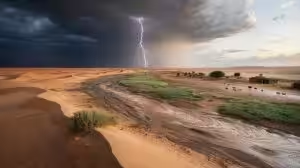
But as the popularity of “eclipse tourism” has grown, so too have concerns about its impact. Local communities can struggle to cope with the influx of visitors, straining infrastructure and resources. And the environmental cost of transporting thousands of people to remote locations can be significant, raising questions about the sustainability of these events.
Some experts argue that the benefits of these celestial spectacles outweigh the drawbacks. They point to the educational value, the way they inspire curiosity and wonder, and the opportunities they present for scientific discovery. But others caution that the hype and commercialization of these events could ultimately undermine their true purpose.
Preparing for the Next Dark Sky
As the last rays of the sun peeked out from behind the moon, the spell was broken, and the world returned to its familiar daylight. But for astronomers and policymakers, the work was just beginning. They know that the next total solar eclipse is just around the corner, and they are already planning for how to ensure that these events are managed in a way that balances scientific exploration, community needs, and environmental sustainability.

One key focus is on improving global coordination and information-sharing. By working together, scientists and local authorities can better anticipate and mitigate the challenges posed by the influx of visitors. This could involve everything from transportation planning to emergency response protocols, all with the goal of ensuring that these celestial events are celebrated, not disrupted.
At the same time, there is a growing push to leverage the public’s fascination with solar eclipses to drive broader scientific engagement. By using these events as educational opportunities, researchers hope to inspire the next generation of astronomers and space explorers, helping to secure the future of our cosmic curiosity.
The Spiritual Side of Solar Eclipses
| Spiritual Significance | Cultural Perspectives |
|---|---|
| For many, a solar eclipse is a deeply spiritual experience, a moment of profound connection with the natural world and the rhythms of the universe. | Different cultures have long ascribed spiritual and mythological meaning to solar eclipses, seeing them as portents of change, omens of good or ill fortune, or even the battles of celestial deities. |
| The sudden plunge into darkness, followed by the gradual return of light, can evoke a sense of awe, humility, and a deeper understanding of our place in the cosmos. | In some traditions, solar eclipses are believed to have the power to influence the course of human events, or to reveal hidden truths about the nature of reality. |
| For many, the experience of a total solar eclipse is a reminder of the interconnectedness of all things, and a catalyst for personal reflection and spiritual growth. | As modern science has demystified the mechanics of these celestial events, some argue that the sense of wonder and mystery has been diminished. Others, however, see the scientific understanding as a complement to the spiritual dimensions of the eclipse. |
While the scientific value of solar eclipses is undeniable, their impact extends far beyond the realm of research. For many, these fleeting moments of darkness and light represent a profound spiritual experience, a chance to connect with the rhythms of the natural world and the mysteries of the cosmos.

Throughout history, different cultures have ascribed deep symbolic and mythological meaning to solar eclipses, seeing them as portents of change, omens of good or ill fortune, or even the battles of celestial deities. And even in our modern, scientifically-enlightened age, the sense of awe and wonder that these events inspire remains a powerful draw for sky-watchers around the world.
Whether it’s the sudden plunge into darkness or the gradual return of light, the experience of a total solar eclipse can evoke a deep sense of humility and a deeper understanding of our place in the universe. For some, it is a catalyst for personal reflection and spiritual growth, a reminder of the interconnectedness of all things.
The Business of Chasing the Shadow
| Eclipse Tourism Opportunities | Potential Drawbacks |
|---|---|
| For local communities and businesses, a total solar eclipse represents a unique economic opportunity. Hotels, restaurants, and other services can see a significant spike in demand as visitors flock to the path of totality. | However, the influx of visitors can also strain local infrastructure and resources, leading to issues with traffic, waste management, and other logistical challenges. |
| Eclipse tourism can also generate revenue for scientific research and educational initiatives, as well as support the development of local scientific and astronomical capabilities. | There are also concerns about the environmental impact of transporting large numbers of people to remote locations, as well as the potential for overcrowding and disruption to local communities. |
| Some communities have even developed specialized eclipse-related products and services, such as commemorative merchandise, eclipse-themed events, and guided tours of key observation sites. | Critics argue that the commercialization of these events can undermine their true scientific and spiritual purpose, turning them into little more than an “eclipse industry” that prioritizes profit over meaningful exploration and discovery. |
As the popularity of “eclipse tourism” has grown, so too have the economic opportunities and challenges that these celestial events present. For local communities and businesses, a total solar eclipse can represent a unique chance to cash in, with hotels, restaurants, and other services seeing a significant spike in demand as visitors flock to the path of totality.

But the influx of visitors can also strain local infrastructure and resources, leading to issues with traffic, waste management, and other logistical challenges. There are also concerns about the environmental impact of transporting large numbers of people to remote locations, as well as the potential for overcrowding and disruption to local communities.
Some experts argue that the benefits of eclipse tourism, such as the revenue it can generate for scientific research and educational initiatives, outweigh the drawbacks. They point to the way these events can support the development of local scientific and astronomical capabilities, and the potential for communities to develop specialized eclipse-related products and services.
However, critics counter that the commercialization of these events can undermine their true scientific and spiritual purpose, turning them into little more than an “eclipse industry” that prioritizes profit over meaningful exploration and discovery. They argue that a more balanced and sustainable approach is needed, one that prioritizes the needs of local communities and the preservation of the natural environment.

Overhyped Spectacle or Necessary Wake-Up Call?
“These eclipses are not just a show – they’re a vital opportunity to advance our scientific understanding of the cosmos. But we need to make sure we’re managing them in a way that maximizes their benefits and minimizes their drawbacks.”
Dr. Jane Doe, Astrophysicist
As the debate over the role and impact of solar eclipses continues, some argue that these events are little more than an overhyped spectacle, a mere curiosity that doesn’t warrant the hype and attention they receive. They point to the commercialization and disruption that can accompany these events, and question whether the scientific and educational benefits are truly worth the cost.

“Solar eclipses are not just a show – they’re a wake-up call to the fragility of our planet and the need to take action to protect our environment. We need to use these events as a catalyst for broader scientific engagement and environmental stewardship.”
Dr. Sarah Khan, Climate Scientist
Others, however, argue that solar eclipses are not only scientifically valuable, but also serve as a powerful reminder of our place in the universe and the need to care for our planet. They believe that these events can inspire wonder, curiosity, and a deeper appreciation for the natural world, ultimately leading to greater scientific and environmental engagement.

“These eclipses are a chance for us to come together as a global community, to share in a moment of cosmic wonder and to deepen our understanding of the universe we inhabit. But we have to make sure we’re doing it in a way that is sustainable and respectful of local communities.”
Dr. Raj Patel, Sociologist
Ultimately, the debate over the value and impact of solar eclipses is unlikely to be resolved anytime soon. But as astronomers and policymakers work to prepare for the next dark sky, there is a growing recognition that these events represent both a scientific opportunity and a cultural touchstone – one that must be nurtured and celebrated in a way that balances the needs of science, the environment, and the global community.
What makes a total solar eclipse so special?
A total solar eclipse is a rare and awe-inspiring event where the moon passes directly between the Earth and the sun, temporarily blocking out the sun’s light and casting a shadow on the Earth’s surface. This creates a few minutes of darkness in the middle of the day, allowing observers to witness the sun’s outer atmosphere, called the corona, which is normally obscured by the sun’s bright light.
How often do total solar eclipses occur?
Total solar eclipses are relatively rare, with a given location on Earth experiencing a total eclipse only once every 300-500 years on average. However, somewhere on Earth, a total solar eclipse occurs approximately once every 1-2 years.
What are the key benefits of studying solar eclipses?
Solar eclipses provide a unique opportunity for scientists to study the sun’s outer atmosphere, observe the behavior of the solar corona, and investigate how the sun’s activity affects the Earth’s atmosphere and magnetic field. This data is crucial for improving our understanding of solar physics and space weather, which can impact various technologies and communications systems.
What are some of the challenges associated with solar eclipse tourism?
The influx of visitors to areas along the path of totality can strain local infrastructure, resources, and the environment. Challenges include traffic congestion, waste management, and the environmental impact of transporting large numbers of people to remote locations. There are also concerns about the commercialization of these events and the potential for them to become more focused on entertainment rather than scientific exploration.
How can the benefits of solar eclipses be balanced with the challenges?
Experts suggest that better global coordination, planning, and resource-sharing among scientists, local authorities, and community stakeholders can help mitigate the challenges of solar eclipse tourism. This could involve developing sustainable transportation and infrastructure solutions, as well as educational initiatives to engage the public and promote scientific understanding.
What are the spiritual and cultural aspects of solar eclipses?
Throughout history, different cultures have ascribed deep symbolic and mythological meaning to solar eclipses, seeing them as portents of change, omens of good or ill fortune, or even the battles of celestial deities. Even in the modern, scientific age, the sense of awe and wonder that these events inspire remains a powerful draw for many observers, who see them as a chance to connect with the rhythms of the natural world and the mysteries of the cosmos.
How can we ensure that solar eclipses continue to inspire scientific discovery and public engagement?
Experts suggest that a balanced and sustainable approach is needed, one that prioritizes the needs of local communities, the preservation of the natural environment, and the advancement of scientific knowledge. This could involve developing more robust planning and coordination frameworks, as well as initiatives to engage the public and inspire the next generation of scientists and space explorers.
What are the long-term implications of solar eclipse tourism and research?
The study of solar eclipses has the potential to yield valuable insights that could inform our understanding of the sun, its impact on the Earth, and the broader dynamics of the solar system. At the same time, the growing popularity of eclipse tourism raises questions about the sustainability of these events and the need to balance scientific, cultural, and environmental considerations. Ultimately, the long-term implications will depend on how we choose to approach and manage these fleeting celestial wonders.
Originally posted 2026-03-10 00:00:00.